Needles, Nerves, and New Tricks: Insulin Injection Tips
Kerry McCawley • June 11, 2020
TL;DR
Giving your first insulin injection can feel overwhelming—even if you’ve lived with type 1 diabetes your whole life. In this personal story, T1D author Kerry McCawley shares how a pump failure forced her to face her fear, and how practicing on a clementine helped her gain the confidence to do it herself.
Updated: April 2, 2026
Living With Type 1 Diabetes Since Childhood
I was diagnosed with type one diabetes when I was 21 months old. I can’t remember my life without diabetes, it’s a part of me and it always will be. Finger pricks, calculating carbs and bolusing are as much a part of my daily routine as brushing my teeth. With that said, I’ve been on an insulin pump from the time I was three years old, so I never had to give myself insulin injections. On the rare occasion that I did need an injection growing up, my mom was always there to give it to me. But for the first time this year, I had to give myself an injection and I was absolutely terrified.
It’s not that I’m afraid of needles, I’ve been dealing with them my whole life. I’ve been checking my sugar for longer than I can remember and started putting in my own insulin pump in the fourth grade. I could probably count how many injections I’ve needed, since I started wearing my pump, on both hands. I was so little when I was diagnosed that I couldn’t take care of my own diabetes and my mother was always the one to give me injections. So, having to give myself an injection seemed impossible.
When My Insulin Pump Failed—and I Had No Choice
It was about the second day of wearing my pump set, and after hopping out of the shower, I had a hard time getting the site to line up properly. I did eventually get it on and assumed that everything was fine. I didn’t even think anything of it when my next blood sugar check was high and simply gave myself a correction. The next time I checked, my blood sugar was above six hundred and I felt sick to my stomach. This is when I realized that my set had been disconnected and despite my efforts to reconnect it, nothing was working. I called the Barbara Davis Center and we made a plan to get my blood sugar back down.
When I got off the phone, I called my mom—who was out of town—crying and told her what was going on. I was sobbing at the thought of having to
give myself an injection. I felt extremely embarrassed that I was 20 and hadn’t given myself one yet. At that point, I didn’t have the clarity that I have now, which is that I was diagnosed at such a young age, that injections weren’t a big part of my diabetes journey and that it was okay for me to be nervous to give myself one for the first time. Luckily, my mom did have that clarity. She reminded me that it was okay to feel nervous. She even told me that she had been terrified the first time she had to give an insulin injection when I was just a baby.
The Clementine Trick: How I Practiced My First Injection
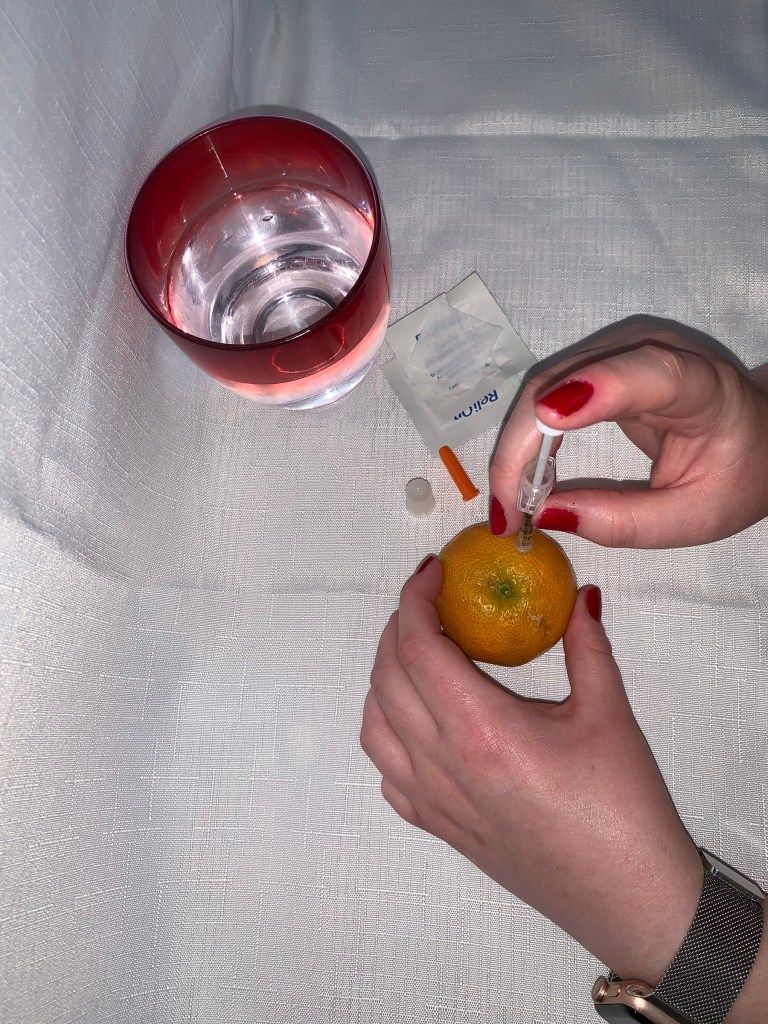
After my mom calmed me down, she FaceTimed me and told me to grab an alcohol swab, syringe, clementine, and a glass of water. I collected the items and she guided me through how to give an injection by having me practice on the clementine. I would have never thought to do this, but my brilliant mother did. I filled my syringe with water and acted as if I was giving myself the injection on the clementine. This helped me to get the feel for what it would be like to give myself the injection. I would recommend to anyone who needs to give themselves their first injection to try this first.
After practicing on the clementine, it was time to give myself the injection. My mom stayed on the phone with me the whole time. My hands were shaking as I drew up the insulin, but I managed to steady them to give myself the shot. After I gave myself the insulin, my nervousness subsided, and I realized how easy it had been to give myself an injection.
What I Learned About Confidence and Diabetes Independence
Hopefully, I won’t need an injection anytime soon, but the next time that I do need one, I can say with confidence that I’ll be able to do it. Maybe giving an injection isn’t a big deal to everyone, but it was a big deal to me, and now I feel immensely proud of myself for doing it. So even if you’re terrified, there’s nothing that you can’t conquer, just take a deep breath and remember that it’s not the end of the world, even if it feels like it in the moment.
About the Author:
Kerry McCawley is a type 1 patient of the Barbara Davis Center and former recipient of CDF’s Charlotte Tucker Scholarship, which she used to attend Metro State University of Denver.
The Power of Screening & Early Detection for Type 1 Diabetes: The Diagnosis I Wish We Could Have Had