Overcoming Insecurities
Graham Daugherty • March 3, 2020
This is part 2 of a 4-part blog series by Trystan H., a recipient of the Charlotte Tucker Scholarship.

Does having diabetes make you insecure? I have had it for seven years and I still get insecure at times. There is no doubt in my mind that my diabetes has developed my strength and made me who I am today, but there are still times that I find myself wondering what other people think about it. I still get days where I find myself thinking: Can I just go this one day without diabetes so no one at the pool will see my infusion set, or I wonder what people think is on my arm, or Are people staring at my CGM?
The reality of the matter is that it is normal for people to feel insecure, so all of these thoughts are normal, they just aren’t healthy to feed into every day. I want to discuss some of the insecurities that I have had with diabetes and how I try to overcome them. I sincerely hope that everyone with diabetes finds peace with themselves and is someday able to live without the insecurities that come with the disease.
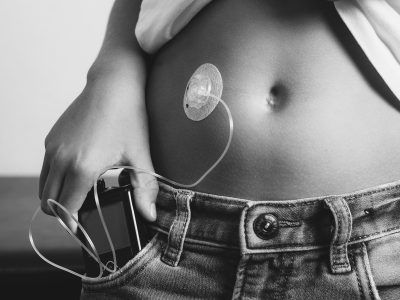
My first insecurity: my insulin pump. It’s big. It falls out of my pockets. It sticks out when I wear dresses. It somehow is always visible no matter what I decide to wear. I have been insecure about my pump since the first time I wore it to school. Let me just say, middle school kids are mean. My peers asked me what was in my pocket all the time, and some of the daring ones ventured to throw out their wild guesses. My pump has been called a catheter, pager, cell phone, microphone, pedometer, flashlight (yep, that’s right, a flashlight), and many other things, some of which were very inappropriate. I began to hate when my pump was visible. Even when my shirt would cover it, people would still see the giant rectangle in my pocket. I tried as hard as I could to keep it out of sight and keep the tubing tucked in for years. Even in my junior year of high school, I purposefully bought a prom dress with pockets so that I could conceal my pump. I had this horrible idea that I would not look pretty at the dance if people could see my pump. How crazy it that? By my senior prom, my mindset had completely changed. I wore my pump hooked onto the back of my dress, and I had a continuous glucose monitor on the back of my arm that everyone could see. That year, I didn’t care. I felt beautiful anyway.
The reason why I didn’t care anymore is because I learned over the course of that year that my pump was my lifeline. If I had to wear it, I needed to accept that. Of course, accepting this did not happen overnight, but I grew more comfortable with people seeing my medical devices over the course of that year. It is hard for me to pinpoint how exactly I changed my mindset, but I do know that it was up to me. I chose to be positive about my devices. If I would not have chosen to be positive, I would probably still be despising the appearance of my pump as I wrote this blog.
My second insecurity: my sensor, or continuous glucose monitor. I wear my sensor in the back of my arm, which is really nice in the winter since nobody can see it underneath my long sleeve shirts. Summertime, however, holds another story. People see my sensor everywhere I go. After I wore the sensor for a while, I got used to it and didn’t mind people being able to see it. Eventually, I started working a summer job that gave me the opportunity to work for children. Every day, without fail, at least one kid would ask me what was on my arm. To most, I simply told them it was medicine since it was the easiest answer for them to understand. At first, when they would touch it or ask me about it constantly, I got kind of annoyed. I had to tell myself to be patient with them since they were little and try to explain it to them the best that I could. Then one day, a little girl asked me what it was. The conversation went like this:
Her: What is that?
Me: Well, it’s like medicine for me.
Her: Why?
Me: I have to wear it to help me stay healthy since I have diabetes.
Her: Does it hurt?
Me: Yeah, sometimes.
Then she kissed her hand and rubbed my sensor to make it feel better. My heart melted. After that conversation, she would come up to me throughout the summer and touch my sensor to make it feel better for the day. When I think about that story, I realize that all people, like the children I worked with, are simply curious about it. If they stare, it is because they want to know more, not because they want to judge me. I overcame this insecurity by realizing that explaining what my sensor is provides an excellent conversation starter to teach others more about diabetes. Don’t let peoples’ curiosity make you insecure about your medical devices. Use your story to educate others, spread knowledge, and raise awareness about diabetes.
My third insecurity: the stigma that revolves around the word “diabetes.” Most people that do not know the difference between type 1 and type 2 diabetes simply assume that diabetic people had unhealthy lifestyles that caused them to get the disease. This really troubled me. I had no control over whether or not I had the disease. I did not want to tell people that I was diabetic because I did not want them to judge my lifestyle or make assumptions about how healthy I was. I always heard my peers or people in movies making jokes about getting diabetes as they ate or drank junk food like cookies and soda. I did not want people to think of jokes like that when they thought of me. Looking back, I can see now that I was embarrassed about having diabetes.
To overcome this embarrassment, I had to realize that diabetes is a part of me. I cannot run from it, ignore it, or avoid it. The only way I can live healthily is to embrace it. I now enjoy telling people that I am diabetic because it provides me yet another opportunity to spread awareness and educate other people about diabetes. If people do decide to judge me or believe that I got the disease due to my own unhealthy habits, then I let them. Other peoples’ judgements do not define who I am, but the way I react to their judgements does. If I cannot change their minds, then I simply move on.
These are the three biggest insecurities that have come into my life since my diagnosis of type 1 diabetes. It has taken me years to overcome these insecurities, and I still have days when I still struggle with them. When I sit in the large classrooms at college, I often find myself wondering how many people are looking at my sensor instead of the instructor. When I find myself doing this, I tell myself that my thoughts are irrational and that most people are not staring at my arm. I address the thought, and then focus on something else.
I want people to know that insecurities are normal, but embracing your diabetes and your lifestyle is important. Everyone deserves to feel comfortable in their own skin, even those with diabetes. Do not let diabetes hold you back from this! Be thankful for your body (even if part of it doesn’t work properly) and embrace the devices and medicine that allow you to live.